For the baseball player, see Mike Tyson (baseball). For the English clergyman and antiquary, see Michael Tyson (antiquary).
| Mike Tyson |
|---|
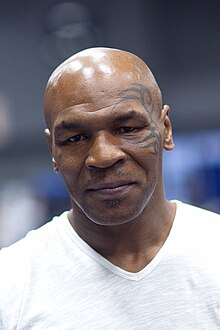
Tyson at SXSW, March 13, 2011
|
| Statistics |
|---|
| Real name | Michael Gerard Tyson |
|---|
| Nickname(s) | The Baddest Man on the Planet[1]
Kid Dynamite
Iron Mike |
|---|
| Rated at | Heavyweight |
|---|
| Height | 5 ft 10 in (178 cm)[2][3][4] |
|---|
| Reach | 71 in (180 cm) |
|---|
| Nationality |  American American |
|---|
| Born | June 30, 1966 (age 49)
Brooklyn, New York City, New York, U.S. |
|---|
| Stance | Orthodox, Peek-a-Boo |
|---|
| Boxing record |
|---|
| Total fights | 58 |
|---|
| Wins | 50 |
|---|
| Wins by KO | 44 |
|---|
| Losses | 6 |
|---|
| Draws | 0 |
|---|
| No contests | 2 |
|---|
Michael Gerard "Mike" Tyson (; born June 30, 1966) is an American retired professional boxer.
Tyson is a former undisputed heavyweight champion of the world and holds the record as the youngest boxer to win the WBC, WBAand IBF heavyweight titles at 20 years, 4 months, and 22 days old. Tyson won his first 19 professional bouts by knockout, 12 of them in the first round. He won the WBC title in 1986 after defeating Trevor Berbick by a TKO in the second round. In 1987, Tyson added the WBA and IBF titles after defeating James Smith and Tony Tucker. He was the first heavyweight boxer to simultaneously hold the WBA, WBC and IBF titles, and the only heavyweight to successively unify them.
In 1988, Tyson became the lineal champion when he knocked out Michael Spinks after 91 seconds. Tyson successfully defended the world heavyweight championship nine times, including victories over Larry Holmes and Frank Bruno. In 1990, he lost his titles to underdog James "Buster" Douglas, by a knockout in round 10. Attempting to regain the titles, he defeated Donovan Ruddock twice in 1991, but he pulled out of a fight with undisputed heavyweight champion Evander Holyfield due to injury. In 1992, Tyson was convicted of raping Desiree Washington and sentenced to six years in prison but was released after serving three years. After his release, he engaged in a series of comeback fights. In 1996, he won the WBC and WBA titles after defeating Frank Bruno and Bruce Seldon by knockout. With his defeat of Bruno, Tyson joined Floyd Patterson, Muhammad Ali, Tim Witherspoon, Evander Holyfield, and George Foreman as the only men in boxing history to that point to have regained a heavyweight championship after having lost it. After being stripped of the WBC title, Tyson lost his WBA crown to Evander Holyfield in November 1996 by an 11th round TKO. Their 1997 rematch ended when Tyson was disqualified for biting Holyfield's ear.
In 2002, he fought for the world heavyweight title at the age of 35, losing by knockout to Lennox Lewis. He retired from professional boxing in 2006, after being knocked out in consecutive matches against Danny Williams and Kevin McBride. Tyson declared bankruptcy in 2003, despite having received over $30 million for several of his fights and $300 million during his career. Tyson was well known for his ferocious and intimidating boxing style as well as his controversial behavior inside and outside the ring. Nicknamed "The Baddest Man on the Planet", "Kid Dynamite", and "Iron Mike",[5] Tyson is considered one of the best heavyweights of all time.[6]He was ranked No. 16 on The Ring's list of 100 greatest punchers of all time,[7] and No. 1 in the ESPN.com list of "The hardest hitters in heavyweight history".[8] He has been inducted into the International Boxing Hall of Fame and the World Boxing Hall of Fame.
Contents
[hide]
- 1 Early life
- 2 Career
- 2.1 Amateur career
- 2.2 Rise to stardom
- 2.3 Undisputed champion
- 2.4 Controversy and upset
- 2.5 After Douglas
- 3 Rape conviction, prison, and conversion
- 4 Comeback
- 5 Tyson–Holyfield fights
- 5.1 Tyson vs. Holyfield I
- 5.2 Tyson vs. Holyfield II and aftermath
- 6 1999 to 2005
- 6.1 After Holyfield
- 6.2 Lewis vs. Tyson
- 6.3 Late career, bankruptcy and retirement
- 7 Exhibition tour
- 8 Legacy
- 9 After professional boxing
- 10 Personal life
- 11 In popular culture
- 12 Professional boxing record
- 13 Pay-per-view bouts
- 14 Boxing championships and accomplishments
- 15 See also
- 16 References
- 17 External links
Early life[edit]
Tyson was born in Brooklyn, New York. He has an elder brother named Rodney (born c. 1961)[9] and had an elder sister named Denise, who died of a heart attack at age 24 in February 1990.[10]
Tyson's biological father is listed as "Purcell Tyson" (who was from Jamaica) on his birth certificate,[11][12] but the man Tyson had known as his father was Jimmy Kirkpatrick. Kirkpatrick was from Grier Town, North Carolina (a predominantly black neighborhood that was annexed by the city of Charlotte),[13] where he was one of the neighborhood's top baseball players. Kirkpatrick married and had a son, Tyson's half-brother Jimmie Lee Kirkpatrick, who would help to integrate Charlotte high school football in 1965. In 1959, Jimmy Kirkpatrick left his family and moved to Brooklyn, where he met Tyson's mother, Lorna Mae (Smith) Tyson. Mike Tyson was born in 1966.[14] Kirkpatrick frequented pool halls, gambled and hung out on the streets. "My father was just a regular street guy caught up in the street world," Tyson said. Kirkpatrick abandoned the Tyson family around the time Mike was born, leaving Tyson's mother to care for the children on her own.[15] Kirkpatrick died in 1992.[16]
The family lived in Bedford-Stuyvesant until their financial burdens necessitated a move to Brownsville when Tyson was 10 years old.[17] Tyson's mother died six years later, leaving 16-year-old Tyson in the care of boxing manager and trainer Cus D'Amato, who would become his legal guardian. Tyson later said, "I never saw my mother happy with me and proud of me for doing something: she only knew me as being a wild kid running the streets, coming home with new clothes that she knew I didn't pay for. I never got a chance to talk to her or know about her. Professionally, it has no effect, but it's crushing emotionally and personally."[18]
Throughout his childhood, Tyson lived in and around high-crime neighborhoods. According to an interview in Details, his first fight was with a bigger youth who had pulled the head off one of Tyson's pigeons.[19] Tyson was repeatedly caught committing petty crimes and fighting those who ridiculed his high-pitched voice and lisp. By the age of 13, he had been arrested 38 times.[20] He ended up at the Tryon School for Boys in Johnstown, New York. Tyson's emerging boxing ability was discovered there by Bobby Stewart, a juvenile detention center counselor and former boxer. Stewart considered Tyson to be an outstanding fighter and trained him for a few months before introducing him to Cus D'Amato.[15] Tyson dropped out of high school as a junior.[21] He would later be awarded an honorary Doctorate in Humane Letters from Central State University in 1989.[22]
Kevin Rooney also trained Tyson, and he was occasionally assisted by Teddy Atlas, although he was dismissed by D'Amato when Tyson was 15. Rooney eventually took over all training duties for the young fighter.[23]
Tyson's brother is a physician assistant in the trauma center of the Los Angeles County-University of Southern California Medical Center.[24] He has always been very supportive of his brother's career and was often seen at Tyson's boxing matches in Las Vegas, Nevada. When asked about their relationship, Mike has been quoted saying, "My brother and I see each other occasionally and we love each other"; and, "My brother was always something and I was nothing."[25]
Career[edit]
Amateur career[edit]
Tyson won gold medals at the 1981 and 1982 Junior Olympic Games, defeating Joe Cortez in 1981 and beating Kelton Brown in 1982. Brown's corner threw in the towel in the first round. He holds the Junior Olympic record for quickest knockout (8 seconds). He won every bout at the Junior Olympic Games by knockout.
He fought Henry Tillman twice as an amateur, losing both bouts by close decision. Tillman went on to win heavyweight gold at the 1984 Summer Olympics in Los Angeles.[26]
Rise to stardom[edit]
Main article: Trevor Berbick vs. Mike Tyson
Tyson made his professional debut as an 18-year-old on March 6, 1985, in Albany, New York. He defeated Hector Mercedes via a first round knockout.[15] He had 15 bouts in his first year as a professional. Fighting frequently, Tyson won 26 of his first 28 fights by KO or TKO; 16 of those came in the first round.[27] The quality of his opponents gradually increased to journeyman fighters and borderline contenders,[27] like James Tillis, David Jaco, Jesse Ferguson, Mitch Green and Marvis Frazier. His win streak attracted media attention and Tyson was billed as the next great heavyweight champion. D'Amato died in November 1985, relatively early into Tyson's professional career; some speculate that his death was the catalyst to many of the troubles Tyson was to experience as his life and career progressed.[28]
Tyson's first nationally televised bout took place on February 16, 1986, at Houston Field House in Troy, New York against journeyman heavyweight Jesse Ferguson. Tyson knocked down Ferguson with an uppercut in the fifth round that broke Ferguson's nose.[29] During the sixth round, Ferguson began to hold and clinch Tyson in an apparent attempt to avoid further punishment. After admonishing Ferguson several times to obey his commands to box, the referee finally stopped the fight near the middle of the sixth round. The fight was initially ruled a win for Tyson by disqualification (DQ) of his opponent. The ruling was "adjusted" to a win by technical knockout (TKO) after Tyson's corner protested that a DQ win would end Tyson's string of knockout victories, and that a knockout would have been the inevitable result. The rationale offered for the revised outcome was that the fight was actually stopped because Ferguson could not (rather than would not) continue boxing.
On November 22, 1986, Tyson was given his first title fight against Trevor Berbick for the World Boxing Council (WBC) heavyweight championship. Tyson won the title by second round TKO, and at the age of 20 years and 4 months became the youngest heavyweight champion in history.[30] Tyson's dominant performance brought many accolades. Donald Saunders wrote: "The noble and manly art of boxing can at least cease worrying about its immediate future, now [that] it has discovered a heavyweight champion fit to stand alongside Dempsey, Tunney, Louis, Marciano and Ali."[31]
Because of Tyson's strength, many fighters were intimidated by him.[32] This was backed up by his outstanding hand speed, accuracy, coordination, power, and timing. Tyson was also noted for his defensive abilities.[33] Holding his hands high in the Peek-a-Boo style taught by his mentor Cus D'Amato,[34] he slipped and weaved out of the way of the opponent's punches while closing the distance to deliver his own punches.[33] One of Tyson's trademark combinations was a right hook to his opponent's body followed by a right uppercut to his opponent's chin; very few boxers would remain standing if caught by this combination. Lorenzo Boyd, Jesse Ferguson and Jose Ribalta were among the boxers knocked down by the combination.
Undisputed champion[edit]
See also: Mike Tyson vs. James Smith, Mike Tyson vs. Tony Tucker and Mike Tyson vs. Michael Spinks
Expectations for Tyson were extremely high, and he embarked on an ambitious campaign to fight all of the top heavyweights in the world. Tyson defended his title against James Smith on March 7, 1987, in Las Vegas, Nevada. He won by unanimous decision and added Smith's World Boxing Association (WBA) title to his existing belt.[35] 'Tyson mania' in the media was becoming rampant.[36] He beat Pinklon Thomas in May with a knockout in the sixth round.[37] On August 1 he took the International Boxing Federation (IBF) title from Tony Tucker in a twelve round unanimous decision.[38] He became the first heavyweight to own all three major belts – WBA, WBC, and IBF – at the same time. Another fight, in October of that year, ended with a victory for Tyson over 1984 Olympic super heavyweight gold medalist Tyrell Biggs by knockout in the seventh round.[39]
During this time, Tyson came to the attention of gaming company Nintendo. After witnessing one of Tyson's fights, Nintendo of America president Minoru Arakawa was impressed by the fighter's "power and skill", prompting him to suggest Tyson be included in the upcoming Nintendo Entertainment System port of the Punch Out!! arcade game. In 1987, Nintendo released Mike Tyson's Punch-Out!!, which was well received and sold more than a million copies.[40]
Tyson had three fights in 1988. He faced Larry Holmes on January 22, 1988, and defeated the legendary former champion by a fourth round KO.[41] This was the only knockout loss Holmes suffered in 75 professional bouts. In March, Tyson then fought contender Tony Tubbs in Tokyo, Japan, fitting in an easy two-round victory amid promotional and marketing work.[42]
On June 27, 1988, Tyson faced Michael Spinks. Spinks, who had taken the heavyweight championship from Larry Holmes via a 15-round decision in 1985, had not lost his title in the ring but was not recognized as champion by the major boxing organizations. Holmes had previously given up all but the IBF title, and that was eventually stripped from Spinks after he elected to fight Gerry Cooney (winning by a 5th-round TKO) rather than IBF Number 1 Contender Tony Tucker, as the Cooney fight provided him a larger purse. However, Spinks did become the lineal champion by beating Holmes and many (including Ring magazine) considered him to have a legitimate claim to being the true heavyweight champion. The bout was, at the time, the richest fight in history and expectations were very high. Boxing pundits were predicting a titanic battle of styles, with Tyson's aggressive infighting conflicting with Spinks' skillful out-boxing and footwork. The fight ended after 91 seconds when Tyson knocked Spinks out in the first round; many consider this to be the pinnacle of Tyson's fame and boxing ability.[43][44] Spinks, previously unbeaten, would never fight professionally again.
Controversy and upset[edit]
Main article: Mike Tyson vs. Buster Douglas
During this period, Tyson's problems outside boxing were also starting to emerge. His marriage to Robin Givens was heading for divorce,[45] and his future contract was being fought over by Don King and Bill Cayton.[46] In late 1988, Tyson parted with manager Bill Cayton and fired longtime trainer Kevin Rooney, the man many credit for honing Tyson's craft after the death of D'Amato.[33][47] Following Rooney's departure, critics alleged that Tyson began to rely less on the jab to get inside and work the body, clinching more, using the Peek-a-Boo style sporadically and throwing few combinations.[48] Tyson insisted he hadn't altered the style that made him a world champion.[49] In 1989, Tyson had only two fights amid personal turmoil. He faced the popular British boxer Frank Bruno in February. Bruno managed to stun Tyson at the end of the 1st round,[50] although Tyson went on to knock out Bruno in the fifth round. Tyson then knocked out Carl "The Truth" Williams in one round in July.[51]
By 1990, Tyson seemed to have lost direction, and his personal life was in disarray amidst reports of less vigorous training prior to the Douglas match.[52] In a fight on February 11, 1990, he lost the undisputed championship to Buster Douglas in Tokyo.[53] Tyson was a huge betting favorite, but Douglas (priced at 42/1) was at an emotional peak after losing his mother to a stroke 23 days prior to the fight; Douglas fought the fight of his life.[53] Contrary to reports that Tyson was out of shape, it has been noted at the time of the fight that he had pronounced muscles, an absence of body fat and weighed 220 and 1/2 pounds, only two pounds more than he had weighed when he beat Michael Spinks 20 months earlier.[54] Mentally, however, Tyson was unprepared. Tyson failed to find a way past Douglas's quick jab that had a 12-inch (30 cm) reach advantage over his own.[55]Tyson did send Douglas to the floor in the eighth round, catching him with an uppercut, but Douglas recovered sufficiently to hand Tyson a heavy beating in the subsequent two rounds. (After the fight, the Tyson camp would complain that the count was slow and that Douglas had taken longer than ten seconds to get to his feet.)[56] Just 35 seconds into the 10th round, Douglas unleashed a brutal uppercut, followed by a combination of hooks that sent Tyson to the canvas for the first time in his career. He was counted out by referee Octavio Meyran.[53]
The knockout victory by Douglas over Tyson, the previously undefeated "baddest man on the planet" and arguably the most feared boxer in professional boxing at that time, has been described as one of the most shocking upsets in modern sports history.[57][58]
After Douglas[edit]
Main articles: Mike Tyson vs. Henry Tillman, Mike Tyson vs. Alex Stewart, Mike Tyson vs. Donovan Ruddock and Mike Tyson vs. Donovan Ruddock II
After the loss, Tyson recovered with first-round knockouts of Henry Tillman[59] and Alex Stewart[60] in his next two fights. Tyson's victory over Tillman, the 1984 Olympic heavyweight gold medalist, enabled Tyson to avenge his amateur losses at Tillman's hands. These bouts set up an elimination match for another shot at the undisputed world heavyweight championship, which Evander Holyfield had taken from Douglas in his first defense of the title.
Tyson, who was the number one contender, faced number two contender Donovan "Razor" Ruddock on March 18, 1991, in Las Vegas. Ruddock was seen as the most dangerous heavyweight around and was thought of as one of the hardest punching heavyweights. Tyson and Ruddock went back and forth for most of the fight, until refereeRichard Steele controversially stopped the fight during the seventh round in favor of Tyson. This decision infuriated the fans in attendance, sparking a post-fight melee in the audience. The referee had to be escorted from the ring.[61]
Tyson and Ruddock met again on June 28 that year, with Tyson knocking down Ruddock twice and winning a 12 round unanimous decision.[62] A fight between Tyson and Holyfield for the undisputed championship was scheduled for November 8, 1991 at Caesars Palace in Las Vegas, but Tyson pulled out after sustaining a rib cartilage injury during training.
Rape conviction, prison, and conversion[edit]
Tyson was arrested in July 1991 for the rape of 18-year-old Desiree Washington, Miss Black Rhode Island, in an Indianapolis hotel room. Tyson's rape trial took place in the Indianapolis courthouse from January 26, 1992 to February 10, 1992.
Desiree Washington testified that she received a phone call from Tyson at 1:36 am on July 19, 1991 inviting her to a party. Having joined Tyson in his limousine, Washington testified that Tyson made sexual advances towards her. She testified that upon arriving at his hotel room, Tyson pinned her down on his bed and raped her despite her pleas to stop. She ran out of the room and asked Tyson's chauffeur to drive her back to her hotel.[citation needed] Partial corroboration of Washington's story came via testimony from Tyson's chauffeur, Virginia Foster, who confirmed Desiree Washington's state of shock. Further testimony came from Thomas Richardson, the emergency room physician who examined Washington more than 24 hours after the incident and confirmed that Washington's physical condition was consistent with rape.[63]
Under lead defense lawyer Vincent J. Fuller's direct examination, Tyson claimed that everything had taken place with Washington's full cooperation and he claimed not to have forced himself upon her. When he was cross-examined by lead prosecutor Gregory Garrison, Tyson denied claims that he had misled Washington and insisted that she wanted to have sex with him. Because of Tyson's hostile and defensive responses to the questions during cross-examination, some have speculated that his behavior made him unlikable to the jury who saw him as brutish and arrogant.[64] Tyson was convicted on the rape charge on February 10, 1992 after the jury deliberated for nearly 10 hours.[65]
Alan Dershowitz, acting as Tyson's counsel, filed an appeal urging error of law in the Court's exclusion of evidence of the victim's past sexual conduct, the exclusion of three potential defense witnesses, and the lack of a jury instruction on honest and reasonable mistake of fact.[66] The Indiana Court of Appeals ruled against Tyson in a 2–1 vote.[66]
On March 26, 1992, Tyson was sentenced to six years in prison followed by four years on probation.[67] He was assigned to the Indiana Youth Center (now the Plainfield Correctional Facility) in April 1992,[68] and he was released in March 1995 after serving three years.[69] Hakeem Olajuwon claims that during his incarceration, Tyson converted to Islam.[70]
Comeback[edit]
Main articles: Mike Tyson vs. Peter McNeeley, Mike Tyson vs. Buster Mathis, Jr., Frank Bruno vs. Mike Tyson II and Bruce Seldon vs. Mike Tyson
After being paroled from prison, Tyson easily won his comeback bouts against Peter McNeeley and Buster Mathis Jr.. Tyson's first comeback fight grossed more than US$96 million worldwide, including a United States record $63 million for PPV television. The fight was purchased by 1.52 million homes, setting both PPV viewership and revenue records.[71] The 89-second fight elicited criticism that Tyson's management lined up "tomato cans" to ensure easy victories for his return.[72] TV Guide included the Tyson-McNeeley fight in their list of the 50 Greatest TV Sports Moments of All Time in 1998.[73]
Tyson regained one belt by easily winning the WBC title from Frank Bruno in March 1996. It was the second fight between the two, and Tyson knocked Bruno out in the third round.[74] Tyson added the WBA belt by defeating champion Bruce Seldon in one round in September that year. Seldon was severely criticized and mocked in the popular press for seemingly collapsing to innocuous punches from Tyson.[75]
Tyson–Holyfield fights[edit]
Tyson vs. Holyfield I[edit]
Main article: Mike Tyson vs. Evander Holyfield
Tyson attempted to defend the WBA title against Evander Holyfield, who was in the fourth fight of his own comeback. Holyfield had retired in 1994 following the loss of his championship to Michael Moorer. It was said that Don King and others saw former champion Holyfield, who was 34 at the time of the fight and a huge underdog, as a washed-up fighter.[76]
On November 9, 1996, in Las Vegas, Nevada, Tyson faced Holyfield in a title bout dubbed "Finally." In a surprising turn of events, Holyfield, who was given virtually no chance to win by numerous commentators,[77] defeated Tyson by TKO when referee Mitch Halpern stopped the bout in round 11.[78] Holyfield became the second boxer to win a heavyweight championship belt three times. Holyfield's victory was marred by allegations from Tyson's camp of Holyfield's frequent headbutts[79] during the bout. Although the headbutts were ruled accidental by the referee,[79] they would become a point of contention in the subsequent rematch.[80]
Tyson vs. Holyfield II and aftermath[edit]
Main article: Evander Holyfield vs. Mike Tyson II
Tyson and Holyfield fought again on June 28, 1997. Originally, Halpern was supposed to be the referee, but after Tyson's camp protested, Halpern stepped aside in favor of Mills Lane.[81] The highly anticipated rematch was dubbed The Sound and the Fury, and it was held at the Las Vegas MGM Grand Garden Arena, site of the first bout. It was a lucrative event, drawing even more attention than the first bout and grossing $100 million. Tyson received $30 million and Holyfield $35 million, the highest paid professionalboxing purses until 2007.[82][83] The fight was purchased by 1.99 million households, setting a pay-per-view buy rate record that stood until the May 5, 2007, De La Hoya-Mayweather boxing match.[83][84]
Soon to become one of the most controversial events in modern sports,[85] the fight was stopped at the end of the third round, with Tyson disqualified[86] for biting Holyfield on both ears. The first time Tyson bit him, the match was temporarily stopped. Referee Mills Lane deducted two points from Tyson and the fight resumed. However, after the match resumed, Tyson did it again; Tyson was disqualified and Holyfield won the match. One bite was severe enough to remove a piece of Holyfield's right ear, which was found on the ring floor after the fight.[87] Tyson later stated that his actions were retaliation for Holyfield repeatedly headbutting him without penalty.[80] In the confusion that followed the ending of the bout and announcement of the decision, a near riot erupted in the arena and several people were injured.[88]
As a subsequent fallout from the incident, US$3 million was immediately withheld from Tyson's $30-million purse by the Nevada state boxing commission (the most it could legally hold back at the time).[89] Two days after the fight, Tyson issued a statement,[90] apologizing to Holyfield for his actions and asked not to be banned for life over the incident.[91]Tyson was roundly condemned in the news media but was not without defenders. Novelist and commentator Katherine Dunn wrote a column that criticized Holyfield's sportsmanship in the controversial bout and charged the news media with being biased against Tyson.[92]
On July 9, 1997, Tyson's boxing license was rescinded by the Nevada State Athletic Commission in a unanimous voice vote; he was also fined US$3 million and ordered to pay the legal costs of the hearing.[93] As most state athletic commissions honor sanctions imposed by other states, this effectively made Tyson unable to box in the United States. The revocation was not permanent, as the commission voted 4–1 to restore Tyson's boxing license on October 18, 1998.[94]
During his time away from boxing in 1998, Tyson made a guest appearance at WrestleMania XIV as an enforcer for the main event match between Shawn Michaels and Steve Austin. During this time, Tyson was also an unofficial member of D-Generation X. Tyson was paid $3 million for being guest enforcer of the match at WrestleMania XIV.[95]
1999 to 2005[edit]
After Holyfield[edit]
Main articles: Mike Tyson vs. Francois Botha and Mike Tyson vs. Andrew Golota
In January 1999, Tyson returned to the ring to fight the South African Francois Botha, in another fight that ended in controversy. While Botha initially controlled the fight, Tyson allegedly attempted to break Botha's arms during a tie-up and both boxers were cautioned by the referee in the ill-tempered bout. Botha was ahead on points on all scorecards and was confident enough to mock Tyson as the fight continued. Nonetheless, Tyson landed a straight right-hand in the fifth round that knocked out Botha.[96] Critics noticed Tyson stopped using the bob and weave defense altogether following this return.[97]
Legal problems caught up with Tyson once again. On February 5, 1999, Tyson was sentenced to a year's imprisonment, fined $5,000, and ordered to serve two years probationand perform 200 hours of community service for assaulting two motorists after a traffic accident on August 31, 1998.[98] He served nine months of that sentence. After his release, he fought Orlin Norris on October 23, 1999. Tyson knocked down Norris with a left hook thrown after the bell sounded to end the first round. Norris injured his knee when he went down and said he was unable to continue the fight. Consequently, the bout was ruled a no contest.[99]
"I'm the best ever. I'm the most brutal and vicious, the most ruthless champion there has ever been. There's no one can stop me. Lennox is a conqueror? No! I'mAlexander! He's no Alexander! I'm the best ever. There's never been anyone as ruthless. I'm Sonny Liston. I'm Jack Dempsey. There's no one like me. I'm from their cloth. There is no one who can match me. My style is impetuous, my defense is impregnable, and I'm just ferocious. I want your heart! I want to eat his children! Praise be to Allah!"
—Tyson's post-fight interview after knocking out Lou Savarese 38 seconds into the bout in June 2000.[100]
In 2000, Tyson had three fights. The first was staged at the MEN Arena, Manchester, England against Julius Francis. Following controversy as to whether Tyson should be allowed into the country, he took four minutes to knock out Francis, ending the bout in the second round.[101] He also foughtLou Savarese in June 2000 in Glasgow, winning in the first round; the fight lasted only 38 seconds. Tyson continued punching after the referee had stopped the fight, knocking the referee to the floor as he tried to separate the boxers.[102] In October, Tyson fought the similarly controversial Andrew Golota,[103] winning in round three after Gołota was unable to continue due to a broken jaw. The result was later changed to no contest after Tyson refused to take a pre-fight drug test and then tested positive for marijuana in a post-fight urine test.[104] Tyson fought only once in 2001, beatingBrian Nielsen in Copenhagen with a seventh round TKO.[105]
Lewis vs. Tyson[edit]
Main article: Lennox Lewis vs. Mike Tyson

The
Lewis-Tyson fight that took place on June 8, 2002, was one of the most anticipated heavyweight fights in years.
Tyson once again had the opportunity to fight for a heavyweight championship in 2002. Lennox Lewis held the WBC, IBF, IBO and Linealtitles at the time. As promising amateurs, Tyson and Lewis had sparred at a training camp in a meeting arranged by Cus D'Amato in 1984.[106] Tyson sought to fight Lewis in Nevada for a more lucrative box-office venue, but the Nevada Boxing Commission refused him a license to box as he was facing possible sexual assault charges at the time.[107]
Two years prior to the bout, Tyson had made several inflammatory remarks to Lewis in an interview following the Savarese fight. The remarks included the statement "I want your heart, I want to eat your children."[108] On January 22, 2002, the two boxers and their entourages were involved in a brawl at a New York press conference to publicize the planned event.[109] The melee put to rest any chance of a Nevada fight, but alternative arrangements were made. The fight eventually occurred on June 8 at the Pyramid Arena in Memphis, Tennessee. Lewis dominated the fight and knocked out Tyson with a right hook in the eighth round. Tyson was respectful after the fight and praised Lewis on his victory.[110] This fight was the highest-grossing event in pay-per-view history at that time, generating $106.9 million from 1.95 million buys in the USA.[83][84]
Late career, bankruptcy and retirement[edit]
In another Memphis fight on February 22, 2003, Tyson beat fringe contender Clifford Etienne 49 seconds into round one. The pre-fight was marred by rumors of Tyson's lack of fitness. Some said that he took time out from training to party in Las Vegas and get a new facialtattoo.[111] This would be Tyson's final professional victory in the ring.
In August 2003, after years of financial struggles, Tyson finally filed for bankruptcy.[112][113] In 2003, amid all his economic troubles, he was named by Ring Magazine at number 16, right behind Sonny Liston, among the 100 greatest punchers of all time.
On August 13, 2003, Tyson entered the ring for a face-to-face confrontation against K-1 fighting phenom Bob Sapp immediately after Sapp's win against Kimo Leopoldo in Las Vegas. K-1 signed Tyson to a contract with the hopes of making a fight happen between the two, but Tyson's felony history made it impossible for him to obtain a visa to enter Japan, where the fight would have been most profitable. Alternative locations were discussed, but the fight ultimately failed to happen.[114]
On July 30, 2004, Tyson faced British boxer Danny Williams in another comeback fight, this time staged in Louisville, Kentucky. Tyson dominated the opening two rounds. The third round was even, with Williams getting in some clean blows and also a few illegal ones, for which he was penalized. In the fourth round, Tyson was unexpectedly knocked out. After the fight, it was revealed that Tyson was trying to fight on one leg, having torn a ligament in his other knee in the first round. This was Tyson's fifth career defeat.[115] He underwent surgery for the ligament four days after the fight. His manager, Shelly Finkel, claimed that Tyson was unable to throw meaningful right-hand punches since he had a knee injury.[116]
On June 11, 2005, Tyson stunned the boxing world by quitting before the start of the seventh round in a close bout against journeyman Kevin McBride. In the 2008 documentaryTyson, he stated that he fought McBride for a payday, that he did not anticipate winning, that he was in poor physical condition and fed up with taking boxing seriously. After losing three of his last four fights, Tyson said he would quit boxing because he felt he had lost his passion for the sport.[117]
When Tyson fired everyone working for him and got new accountants in 2000, they prepared a statement showing he started the year $3.3 million in the hole but made $65.7 million.[118] "The problem was that I spent $62 million that year,' Tyson said, "I just said to myself, Wow, this is over. Now I can go out and really have fun.".[118] In August 2007, Tyson pleaded guilty to drug possession and driving under the influence in an Arizona court, which stemmed from an arrest in December where authorities said Tyson, who has a long history of legal problems, admitted to using cocaine that day and to being addicted to the drug.[119]
Exhibition tour[edit]
To help pay off his debts, Tyson returned to the ring in 2006 for a series of four-round exhibitions against journeyman heavyweight Corey "T-Rex" Sanders in Youngstown, Ohio.[120] Tyson, without headgear at 5 ft 10.5 in and 216 pounds, was in great shape, but far from his prime against Sanders, with headgear at 6 ft 8 in and 293 pounds, a loser of his last seven pro bouts and nearly blind from a detached retina in his left eye. Tyson appeared to be "holding back" in these exhibitions to prevent an early end to the "show". "If I don't get out of this financial quagmire there's a possibility I may have to be a punching bag for somebody. The money I make isn't going to help my bills from a tremendous standpoint, but I'm going to feel better about myself. I'm not going to be depressed," explained Tyson about the reasons for his "comeback".[121]
Legacy[edit]
A 1998 ranking of "The Greatest Heavyweights of All-Time" by Ring magazine placed Tyson at No.14 on the list.[122] Despite criticism of facing underwhelming competition during his unbeaten run as champion, Tyson's knockout power and intimidation factor made him the sport's most dynamic box office attraction.[123] According to Douglas Quenqua ofThe New York Times, "The [1990s] began with Mike Tyson, considered by many to be the last great heavyweight champion, losing his title to the little-known Buster Douglas. Seven years later, Mr. Tyson bit Evander Holyfield's ear in a heavyweight champion bout — hardly a proud moment for the sport."[124]
In Ring Magazine's list of the 80 Best Fighters of the Last 80 Years, released in 2002, Tyson was ranked at No. 72.[125] He is ranked No. 16 on Ring Magazine's 2003 list of 100 greatest punchers of all time.[126]
On June 12, 2011, Tyson was inducted to the International Boxing Hall of Fame alongside legendary Mexican champion Julio César Chávez, light welterweight champion Kostya Tszyu, and actor/screenwriter Sylvester Stallone.[127]
After professional boxing[edit]

Tyson in the ring at Las Vegas in October 2006
In an interview with USA Today published on June 3, 2005, Tyson said, "My whole life has been a waste – I've been a failure." He continued: "I just want to escape. I'm really embarrassed with myself and my life. I want to be a missionary. I think I could do that while keeping my dignity without letting people know they chased me out of the country. I want to get this part of my life over as soon as possible. In this country nothing good is going to come of me. People put me so high; I wanted to tear that image down."[128] Tyson began to spend much of his time tending to his 350 pigeons in Paradise Valley, an upscale enclave near Phoenix, Arizona.[129]
Tyson has stayed in the limelight by promoting various websites and companies.[130] In the past Tyson had shunned endorsements, accusing other athletes of putting on a false front to obtain them.[131] Tyson has held entertainment boxing shows at a casino in Las Vegas[132] and started a tour of exhibition bouts to pay off his numerous debts.[133]
On December 29, 2006, Tyson was arrested in Scottsdale, Arizona, on suspicion of DUI and felony drug possession; he nearly crashed into a police SUV shortly after leaving a nightclub. According to a police probable-cause statement, filed in Maricopa County Superior Court, "[Tyson] admitted to using [drugs] today and stated he is an addict and has a problem."[134] Tyson pleaded not guilty on January 22, 2007 in Maricopa County Superior Court to felony drug possession and paraphernalia possession counts and two misdemeanor counts of driving under the influence of drugs. On February 8 he checked himself into an inpatient treatment program for "various addictions" while awaiting trial on the drug charges.[135]
On September 24, 2007, Mike Tyson pleaded guilty to possession of cocaine and driving under the influence. He was convicted of these charges in November 2007 and sentenced to 24 hours in jail, 360 hours community service and 3 years probation. Prosecutors had requested a year-long jail sentence, but the judge praised Tyson for seeking help with his drug problems.[136] On November 11, 2009, Mike Tyson was arrested after getting into a scuffle at Los Angeles International airport with a photographer.[137] No charges were filed.
Tyson has taken acting roles in movies and television, most famously playing a fictionalized version of himself in the 2009 film The Hangover. Tyson has continued to appear in the WWE.
For more details on on his acting and WWE appearances, see Mike Tyson in popular culture.
In September 2011, Tyson gave an interview in which he made comments about former Alaska governor Sarah Palin that included crude and violent descriptions of interracial sex. These comments were then reprinted on the Daily Caller website. Journalist Greta van Susterencriticized Tyson and the Daily Caller over the comments, which she described as "smut" and "violence against women".[138]
After debuting a one-man show in Las Vegas, Tyson teamed up with director Spike Lee and brought the show to Broadway in August 2012.[139][140] In February 2013, Tyson took his one-man show Mike Tyson: Undisputed Truth on a 36-city, three-month national tour. Tyson talks about his personal and professional life on stage.[141] The one-man show was aired on HBO on November 16, 2013.
In October 2012, Tyson launched the Mike Tyson Cares Foundation.[142] The mission of the Mike Tyson Cares Foundation is to "give kids a fighting chance" by providing innovative centers that provide for the comprehensive needs of kids from broken homes.
In August 2013, Tyson teamed up with Acquinity Interactive CEO Garry Jonas to form Iron Mike Productions, a boxing promotions company, formerly known as Acquinity Sports.
In September 2013, Tyson was featured on a six-episode television series on Fox Sports 1 that documented his personal and private life entitled "Being Mike Tyson".[143][144]
In November 2013, Tyson released his book Undisputed Truth, which also made it on the The New York Times Best Seller list.[145] An animated series named Mike Tyson Mysteries, featuring Tyson solving mysteries in the style of Scooby Doo, premiered on Adult Swim in late October 2014.[146]
In early March 2015, Tyson featured, with Chance the Rapper, on a song from Madonna's album, Rebel Heart. On the track, 'Iconic', Tyson says some lines at the beginning of the song.[147]
In late March 2015, Ip Man 3 was announced. With Donnie Yen reprising his role as the titular character, Bruce Lee's martial arts master, Ip Man, while Mike Tyson has been confirmed to join the cast.[148] Donnie Yen has since mentioned that he is a big fan of Mike Tyson, and has watched many of his professional boxing bouts, and is excited to work with him. Tyson stated during a press conference that he is a huge fan of Donnie Yen, and has watched the first two Ip Man movies more than three times each and is honored to be invited for the final installment of the trilogy.[149]
Principal photography has begun on March 25, 2015, with a tentative release date of Lunar New Year 2016, in 3D.
Personal life[edit]

The gates of Tyson's mansion in
Southington, Ohio, which he purchased and lived in during the 1980s.
[150]
Tyson has been married three times. He has fathered eight children, one deceased, by several women; in addition to his biological children, Tyson includes the oldest daughter of his second wife as one of his own.[151]
His first marriage was to actress Robin Givens, from February 7, 1988 to February 14, 1989.[45] Givens was famous for her work on the sitcom Head of the Class. Tyson's marriage to Givens was especially tumultuous, with allegations of violence, spousal abuse and mental instability on Tyson's part.[152] Matters came to a head when Tyson and Givens gave a joint interview with Barbara Walters on the ABC TVnewsmagazine show 20/20 in September 1988, in which Givens described life with Tyson as "torture, pure hell, worse than anything I could possibly imagine."[153] Givens also described Tyson as "manic depressive" on national television while Tyson looked on with an intent and calm expression.[152] A month later, Givens announced that she was seeking a divorce from the allegedly abusive Tyson.[152]They had no children but she reported having had a miscarriage; Tyson reports that she was never pregnant and only used that to get him to marry her.[152][154] During their marriage, the couple lived in a mansion in Bernardsville, New Jersey.[155][156]
His second marriage was to Monica Turner from April 19, 1997 to January 14, 2003.[157] At the time of the divorce filing, Turner worked as a pediatric resident at Georgetown University Medical Center in Washington DC.[158] She is the sister of Michael Steele, the former Lieutenant Governor of Maryland and former Republican National Committee Chairman.[159] Turner filed for divorce from Tyson in January 2002, claiming that he committed adultery during their five-year marriage, an act that "has neither been forgiven nor condoned."[158] The couple had two children, Rayna and Amir.
On May 25, 2009, Tyson's four-year-old daughter Exodus was found by her seven-year-old brother Miguel, unconscious and tangled in a cord, dangling from an exercise treadmill. The child's mother untangled her, administered CPR and called for medical attention. She died of her injuries on May 26, 2009.[160][161]
Eleven days after his daughter's death, Tyson wed for the third time, to longtime girlfriend Lakiha "Kiki" Spicer, age 32, exchanging vows on Saturday, June 6, 2009, in a short, private ceremony at the La Bella Wedding Chapel at the Las Vegas Hilton.[162]
Tyson has been diagnosed with bipolar disorder.[163] While on the American talk show The View in early May 2010, Tyson revealed that he is now forced to live paycheck to paycheck.[164] He went on to say: "I'm totally destitute and broke. But I have an awesome life, I have an awesome wife who cares about me. I'm totally broke. I had a lot of fun. It [his poverty] just happened. I'm very grateful. I don't deserve to have the wife that I have; I don't deserve the kids that I have, but I do, and I'm very grateful."
In March 2011, Tyson appeared on The Ellen DeGeneres Show to discuss his new Animal Planet reality series, Taking on Tyson. In the interview with DeGeneres, Tyson discussed some of the ways he had improved his life in the past two years, including sober living and a vegan diet.[165] However, in August 2013 he admitted publicly that he had lied about his sobriety and was on the verge of death from alcoholism.[166]
In December 2013, during an interview with Fox News, Tyson talked about his progress with sobriety and how being in the company of good people has made him want to be a better and more humble person. Tyson also talked about religion and said that he is very grateful to be a Muslim and that he needs Allah.[167] He also revealed that he is no longer vegan after four years.[167]
In popular culture[edit]
For more details on this topic, see Mike Tyson in popular culture.
At the height of his fame and career in the late 1980s and throughout the 1990s, Tyson was one of the most recognized sports personalities in the world. Apart from his many sporting accomplishments, his outrageous and controversial behavior in the ring and in his private life has kept him in the public eye and in the courtroom.[168] As such, Tyson has appeared in myriad popular media in cameo appearances in film and television. He has also been featured in video games and as a subject of parody or satire.
The film Tyson was released in 1995 and was directed by Uli Edel. It explores the life of Mike Tyson, from the death of his guardian and trainer Cus D'Amato to his rape conviction. Tyson is played by Michael Jai White.
Published in 2007, author Joe Layden's book The Last Great Fight: The Extraordinary Tale of Two Men and How One Fight Changed Their Lives Forever, chronicled the lives of Tyson and Douglas before and after their heavyweight championship fight. The book received positive reviews and claimed the fight was essentially the beginning of the end of boxing's popularity in mainstream sports.
In 2008, the critically acclaimed documentary Tyson premiered at the annual Cannes Film Festival in France. The film was directed by James Toback and has interviews with Tyson and clips of his fights and from his personal life.
The Felice Brothers, a folk-rock band from Upstate New York, released a song on their 2011 album Celebration, Florida titled "Cus's Catskill Gym". The song tells the story, albeit briefly, of Mike Tyson and a few notable characters and moments in his life.[citation needed]
Professional boxing record[edit]
| 50 Wins (44 knockouts, 5 decisions, 1 disqualification), 6 Losses, 0 Draws, 2 No Contests[169] |
| Res. | Record | Opponent | Type | Rd., Time | Date | Location | Notes |
| Loss | 50–6–(2) |  Kevin McBride Kevin McBride | TKO | 6 (10), 3:00 | 2005-06-11 |  MCI Center, Washington, D.C. MCI Center, Washington, D.C. | |
| Loss | 50–5–(2) |  Danny Williams Danny Williams | KO | 4 (10), 2:51 | 2004-07-30 | Freedom Hall State Fairground,Louisville, Kentucky | |
| Win | 50–4–(2) | Clifford Etienne | KO | 1 (10), 0:49 | 2003-02-22 | The Pyramid, Memphis, Tennessee | |
| Loss | 49–4–(2) | Lennox Lewis | KO | 8 (12), 2:25 | 2002-06-08 | The Pyramid, Memphis, Tennessee | For The Ring, Lineal, WBC, IBO & IBF Heavyweight titles.
The Ring Magazine Knockout of the Year. |
| Win | 49–3–(2) |  Brian Nielsen Brian Nielsen | RTD | 7 (10), 3:00 | 2001-10-13 | Parken Stadium, Copenhagen | |
| NC | 48–3–(2) |  Andrew Golota Andrew Golota | NC | 3 (10) | 2000-10-20 | The Palace, Auburn Hills, Michigan | Originally a TKO win for Tyson after two rounds; changed to No Contest after Tyson tested positive forcannabis in the post-fight drug test. |
| Win | 48–3–(1) | Lou Savarese | TKO | 1 (10), 0:38 | 2000-06-24 | Hampden Park, Glasgow, Scotland | |
| Win | 47–3–(1) | Julius Francis | TKO | 2 (10), 1:03 | 2000-01-29 | M.E.N. Arena, Manchester, Greater Manchester | |
| NC | 46–3–(1) | Orlin Norris | NC | 1 (10), 3:00 | 1999-10-23 | MGM Grand Garden Arena, Las Vegas, Nevada | Norris was unable to continue after Tyson hit Norris after the bell and Norris injured his knee in the knockdown. |
| Win | 46–3 |  Francois Botha Francois Botha | KO | 5 (10), 2:59 | 1999-01-16 | MGM Grand Garden Arena, Las Vegas, Nevada | |
| Loss | 45–3 | Evander Holyfield | DQ | 3 (12) | 1997-06-28 | MGM Grand Garden Arena, Las Vegas, Nevada | For WBA Heavyweight title.
The Ring Magazine Event of the Year. |
| Loss | 45–2 | Evander Holyfield | TKO | 11 (12), 0:37 | 1996-11-09 | MGM Grand Garden Arena, Las Vegas, Nevada | Lost WBA Heavyweight title.
The Ring Magazine Fight of the Year & Upset of the Year. |
| Win | 45–1 | Bruce Seldon | TKO | 1 (12), 1:49 | 1996-09-07 | MGM Grand Garden Arena, Las Vegas, Nevada | Won WBA Heavyweight title. |
| Win | 44–1 | Frank Bruno | TKO | 3 (12), 0:50 | 1996-03-16 | MGM Grand Garden Arena, Las Vegas, Nevada | Won WBC Heavyweight title. |
| Win | 43–1 | Buster Mathis, Jr. | KO | 3 (12), 2:32 | 1995-12-16 | Core States Spectrum, Philadelphia,Pennsylvania | |
| Win | 42–1 | Peter McNeeley | DQ | 1 (10), 1:29 | 1995-08-19 | MGM Grand Garden Arena, Las Vegas, Nevada | |
| Win | 41–1 |  Donovan Ruddock Donovan Ruddock | UD | 12 | 1991-06-28 | Mirage Hotel & Casino, Las Vegas,Nevada | |
| Win | 40–1 | Donovan Ruddock | TKO | 7 (12), 2:22 | 1991-03-18 | Mirage Hotel & Casino, Las Vegas,Nevada | |
| Win | 39–1 | Alex Stewart | TKO | 1 (10), 2:27 | 1990-12-08 | Convention Center, Atlantic City, New Jersey | |
| Win | 38–1 | Henry Tillman | KO | 1 (10), 2:47 | 1990-06-16 | Caesars Palace, Las Vegas, Nevada | |
| Loss | 37–1 | Buster Douglas | KO | 10 (12), 1:22 | 1990-02-11 |  Tokyo Dome, Tokyo Tokyo Dome, Tokyo | Lost The Ring, WBC, WBA & IBF Heavyweight titles.
The Ring Magazine Upset of the Year. |
| Win | 37–0 | Carl Williams | TKO | 1 (12), 1:33 | 1989-07-21 | Convention Center, Atlantic City, New Jersey | Retained The Ring, WBC, WBA & IBF Heavyweight titles. |
| Win | 36–0 | Frank Bruno | TKO | 5 (12), 2:55 | 1989-02-25 | Hilton Hotel, Las Vegas, Nevada | Retained The Ring, WBC, WBA & IBF Heavyweight titles. |
| Win | 35–0 | Michael Spinks | KO | 1 (12), 1:31 | 1988-06-27 | Convention Hall, Atlantic City, New Jersey | Retained WBC, WBA & IBF Heavyweight titles.
Won The Ring Heavyweight title. |
| Win | 34–0 | Tony Tubbs | TKO | 2 (12), 2:54 | 1988-03-21 | Tokyo Dome, Tokyo | Retained WBC, WBA & IBF Heavyweight titles. |
| Win | 33–0 | Larry Holmes | TKO | 4 (12), 2:55 | 1988-01-22 | Convention Hall, Atlantic City, New Jersey | Retained WBC, WBA & IBF Heavyweight titles. |
| Win | 32–0 | Tyrell Biggs | TKO | 7 (12), 2:59 | 1987-10-16 | Convention Hall, Atlantic City, New Jersey | Retained WBC, WBA & IBF Heavyweight titles. |
| Win | 31–0 | Tony Tucker | UD | 12 | 1987-08-01 | Hilton Hotel, Las Vegas, Nevada | Retained WBC & WBA Heavyweight titles.
Won IBF Heavyweight title. |
| Win | 30–0 | Pinklon Thomas | TKO | 6 (12), 2:00 | 1987-05-30 | Hilton Hotel, Las Vegas, Nevada | Retained WBC & WBA Heavyweight titles. |
| Win | 29–0 | James Smith | UD | 12 | 1987-03-07 | Hilton Hotel, Las Vegas, Nevada | Retained WBC Heavyweight title.
Won WBA Heavyweight title. |
| Win | 28–0 | Trevor Berbick | TKO | 2 (12), 2:35 | 1986-11-22 | Hilton Hotel, Las Vegas, Nevada | Won WBC Heavyweight title. |
| Win | 27–0 | Alfonso Ratliff | TKO | 2 (10), 1:41 | 1986-09-06 | Hilton Hotel, Las Vegas, Nevada | |
| Win | 26–0 |  José Ribalta José Ribalta | TKO | 10 (10), 1:37 | 1986-08-17 | Trump Plaza Hotel, Atlantic City, New Jersey | |
| Win | 25–0 | Marvis Frazier | KO | 1 (10), 0:30 | 1986-07-26 | Civic Center, Glens Falls, New York | |
| Win | 24–0 | Lorenzo Boyd | KO | 2 (10), 1:43 | 1986-07-11 | Stevensville Hotel, Swan Lake, New York | |
| Win | 23–0 | William Hosea | KO | 1 (10), 2:03 | 1986-06-28 | Houston Field House, Troy, New York | |
| Win | 22–0 | Reggie Gross | TKO | 1 (10), 2:36 | 1986-06-13 | Madison Square Garden, New York City, New York | |
| Win | 21–0 | Mitch Green | UD | 10 | 1986-05-20 | Madison Square Garden, New York City, New York | |
| Win | 20–0 | James Tillis | UD | 10 | 1986-05-09 | Civic Center, Glens Falls, New York | |
| Win | 19–0 | Steve Zouski | KO | 3 (10), 2:39 | 1986-03-10 | Nassau Coliseum, Uniondale, New York | |
| Win | 18–0 | Jesse Ferguson | TKO | 6 (10), 1:19 | 1986-02-16 | Houston Field House, Troy, New York | Originally a disqualification win for Tyson; changed to TKO win for Tyson. |
| Win | 17–0 | Mike Jameson | TKO | 5 (8), 0:46 | 1986-01-24 | Trump Plaza Hotel, Atlantic City, New Jersey | |
| Win | 16–0 | David Jaco | TKO | 1 (10), 2:16 | 1986-01-11 | Plaza Convention Center, Albany,New York | |
| Win | 15–0 | Mark Young | TKO | 1 (10), 0:50 | 1985-12-27 | Latham Coliseum, Latham, New York | |
| Win | 14–0 | Sammy Scaff | TKO | 1 (10), 1:19 | 1985-12-06 | Felt Forum, New York | |
| Win | 13–0 | Conroy Nelson | TKO | 2 (8), 0:30 | 1985-11-22 | Latham Coliseum, Latham, New York | |
| Win | 12–0 | Eddie Richardson | KO | 1 (8), 1:17 | 1985-11-13 | Ramada-Houston Hotel, Houston,Texas | |
| Win | 11–0 |  Sterling Benjamin Sterling Benjamin | TKO | 1 (8), 0:54 | 1985-11-01 | Latham Coliseum, Latham, New York | |
| Win | 10–0 | Robert Colay | KO | 1 (8), 0:37 | 1985-10-25 | Atlantis Hotel & Casino, Atlantic City,New Jersey | |
| Win | 9–0 | Donnie Long | TKO | 1 (6), 1:28 | 1985-10-09 | Trump Casino Hotel, Atlantic City,New Jersey | |
| Win | 8–0 | Michael Johnson | KO | 1 (6), 0:39 | 1985-09-05 | Atlantis Hotel & Casino, Atlantic City,New Jersey | |
| Win | 7–0 | Lorenzo Canady | KO | 1 (6), 1:05 | 1985-08-15 | Resorts International, Atlantic City,New Jersey | |
| Win | 6–0 | Larry Sims | KO | 3 (6), 2:04 | 1985-07-19 | Mid-Hudson Civic Center,Poughkeepsie, New York | |
| Win | 5–0 | John Alderson | TKO | 2 (6), 3:00 | 1985-07-11 | Trump Casino Hotel, Atlantic City,New Jersey | |
| Win | 4–0 | Ricardo Spain | TKO | 1 (6), 0:39 | 1985-06-20 | Resorts International, Atlantic City,New Jersey | |
| Win | 3–0 | Don Halpin | KO | 4 (4), 1:04 | 1985-05-23 | Albany, New York | |
| Win | 2–0 | Trent Singleton | TKO | 1 (4), 0:52 | 1985-04-10 | Albany, New York | |
| Win | 1–0 |  Hector Mercedes Hector Mercedes | TKO | 1 (4), 1:47 | 1985-03-06 | Plaza Convention Center, Albany,New York | Professional debut. |
Pay-per-view bouts[edit]
| Date | Fight | Billing | Buys | Network |
|---|
June 27, 1988
| Tyson vs. Spinks | Once and For All |
700,000
| King Vision |
March 18, 1991
| Tyson vs. Ruddock | The Fight of the Year |
959,000
| King Vision |
June 28, 1991
| Tyson vs. Ruddock II | The Rematch |
1,250,000
| King Vision |
August 19, 1995
| Tyson vs. McNeeley | He's Back |
1,550,000
| Showtime & King Vision |
March 16, 1996
| Bruno vs. Tyson II | The Championship Part 1 |
1,370,000
| Showtime & King Vision |
September 7, 1996
| Seldon vs. Tyson | The Championship Part 2 |
1,150,000[170]
| Showtime & King Vision |
November 9, 1996
| Tyson vs. Holyfield | Finally |
1,590,000
| Showtime & King Vision |
June 28, 1997
| Holyfield vs. Tyson II | The Sound and the Fury |
1,990,000
| Showtime & King Vision |
Jan 16, 1999
| Tyson vs. Botha | Tyson-Botha |
750,000
| Showtime |
October 20, 2000
| Tyson vs. Golota | Showdown in Motown |
450,000
| Showtime |
June 8, 2002
| Lewis vs. Tyson | Lewis-Tyson Is On |
1,970,000
| HBO & Showtime |
February 22, 2003
| Tyson vs. Etienne | Back to Business |
100,000
| Showtime |
July 30, 2004
| Tyson vs. Williams | Return for Revenge |
150,000
| Showtime |
June 11, 2005
| Tyson vs. McBride | Tyson-McBride |
250,000
| Showtime |
Boxing championships and accomplishments[edit]
Tyson established an impressive list of accomplishments, mostly early in his career:[171]
Titles
- Junior Olympic Games Champion Heavyweight 1982
- National Golden Gloves Champion Heavyweight 1984
- Undisputed Heavyweight champion (held all three major championship belts; WBA, IBF, and WBC) – August 1, 1987 – February 11, 1990
- WBC Heavyweight Champion – November 22, 1986 – February 11, 1990, March 16, 1996 – September 24, 1996 (Vacated)
- WBA Heavyweight Champion – March 7, 1987 – February 11, 1990, September 7, 1996 – November 9, 1996
- IBF Heavyweight Champion – August 1, 1987 – February 11, 1990
Records
- Youngest Heavyweight champion – 20 years and 4 months
- Junior Olympic quickest KO – 8 seconds
Awards
- Ring Magazine Fighter of the Year—1986 & 1988
- BBC Sports Personality of the Year Overseas Personality—1989
- Ring magazine Prospect of the Year—1985
Professional wrestling
- WWE Hall of Fame (Class of 2012) [172]
See also[edit]
 Mike Tyson – Wikipedia book


